Dangerous Imaginations
Ten Sundays in the parables of Jesus, read alongside Octavia Butler, adrienne maree brown and the Afrofuturist tradition: what does it take to imagine God’s future after living so long inside someone else’s?
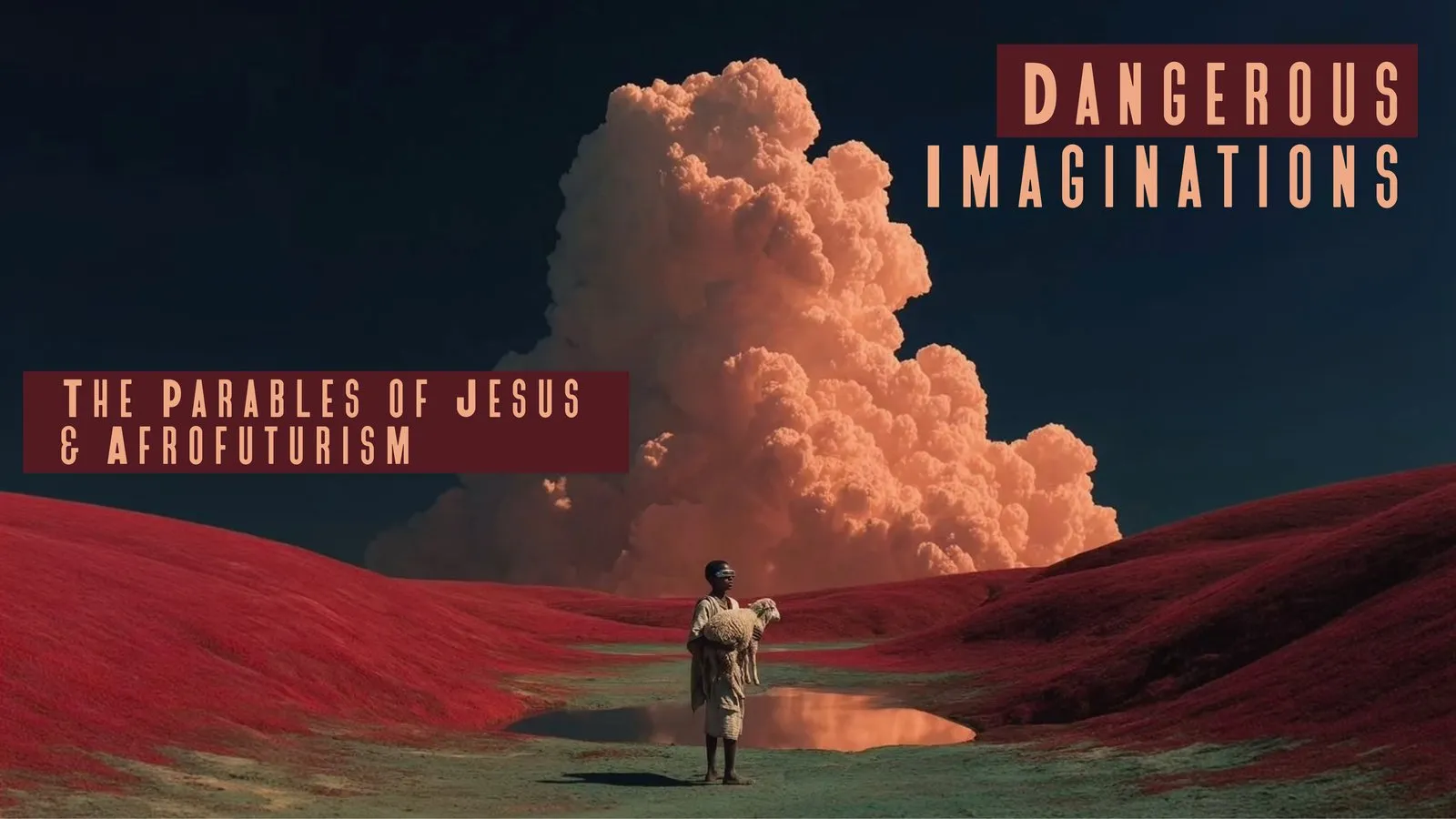
About the series
Jesus told parables to people living under Roman occupation, people with every reason to believe the world would keep running the way Rome ran it. So he talked about a mustard seed. A woman working yeast into a batch of dough. A widow who wouldn’t stop knocking, a field with treasure buried in it, a banquet where the guest list gets thrown out. Farmers, day laborers and bridesmaids, hardly any religious language, and under every story the same stubborn claim: the world can be otherwise, and you’re allowed to picture it.
For ten Sundays in the summer of 2026 we read those stories alongside Afrofuturism, the tradition of Black art, music and fiction that imagines Black people into the futures other people tried to write them out of. adrienne maree brown gave us a place to start:
Imagination is one of the spoils of colonization, which in many ways is claiming who gets to imagine the future for a given geography. Losing our imagination is a symptom of trauma. Reclaiming the right to dream the future, strengthening the muscle to imagine together as Black people, is a revolutionary decolonizing activity.
The series began with a hunch. When God’s future feels impossible to picture, it’s often because we’ve lived so long inside someone else’s imagination that we’ve forgotten we have one. Jesus’ parables hand it back, which is what makes them dangerous.
Octavia Butler came up in six of the ten sermons, most often through Parable of the Sower, whose young narrator writes her own scripture while her world comes apart. The preachers also reached for Kindred, Buffy Summers, Encanto, Janelle Monáe’s Dirty Computer, and the 1969 Harlem Cultural Festival, whose footage sat in a basement for fifty years until Questlove made Summer of Soul.
How the series moves
The ten weeks fall into four movements. The first three Sundays wake the imagination with small things that hold the whole: a mustard seed and a pinch of yeast, a sower, a persistent widow. The next two look at what blocks it, with a rich man’s gate and a landowner’s payroll. Weeks six through eight are about training and tending it, with the treasure and the pearl, the ten bridesmaids, and the two sons. The last two Sundays turn toward living it out: a woman who sweeps the whole house for one coin, and a banquet table thrown open to people nobody planned to invite.
10 sermons, in order
Community group guide
One week per Sunday. Listen to the sermon together or ahead of time. Start with the opening question, which works even for someone who missed the sermon, then choose the discussion questions that fit your group. Few groups get through all of them. Sharing is optional, and “pass” is a complete answer.
Week 1 · Jun 28The Mustard Seed and the Yeast Matthew 13:31–33
Open
When you were a kid, did you ever build a fort, invent a game, or make up a world where things were fair? What do you remember imagining?
Discuss
- Tonetta passed black mustard seeds around the room. People in Jesus’ day pictured great kingdoms as towering trees. Why do you think he compared God’s kingdom to a seed you could lose in the carpet?
- Tonetta said empire “doesn’t just control your body. It tries to control your imagination. It tries to make you believe that the world as it is, is the world that has to be.” Where do you feel that pressure, out in the culture or in your own head?
- In Jesus’ day yeast usually stood for contamination (“beware the yeast of the Pharisees”), and he used it anyway, for what Tonetta called “an invasive species of love and justice and welcome that you cannot stop from spreading.” What changes when you hear the kingdom described that way?
- The woman mixing yeast into fifty pounds of flour, Tonetta noticed, “is not struggling. She isn’t exhausted.” She’s in on the secret of how the kingdom works. What would it look like to work for change that way?
- “The small is not less than,” Tonetta said. “The small is how it works.” Her list of mustard seeds ran from how you treat your little brother to whether grief and rage get to shut off your joy. Which small practice is hardest for you to believe matters?
- Tonetta called imagination “a spiritual practice,” the way “the kingdom of heaven actually moves.” Wherever you’d place yourself on faith right now, what do you make of that?
This week
Tonetta ended by asking the room to call out one impossible thing they wish were real. People named a stable housing market, an end to homelessness, student loan forgiveness. Each person names one. Then pick one small, ordinary action that points toward it, and do it this week without trying to force the outcome.
Close in prayer
Invite people to name, aloud or silently, the small seeds they’re carrying. Pray for the trust to plant them without needing to control how they grow.
Week 2 · Jul 5The Sower Mark 4:1–20
Open
Think of a book, film or show that imagines a very different future, hopeful or bleak. What has stuck with you about it?
Discuss
- The same seed lands on four kinds of ground and gets four different outcomes. What do you notice about Jesus putting the attention on the soil instead of the seed?
- Jesus names worry, the lure of wealth and the desire for other things as thorns that choke the word (Mark 4:19). Which of those feels most real for you right now?
- adrienne maree brown says we are in an “imagination battle,” and Tonetta asked whose imagination gets centered when we picture the future. Where do you see that battle playing out around you?
- Ched Myers reads the parable’s enormous harvest, thirty and sixty and a hundredfold, as enough to break a peasant farmer’s debt to the landlord. How does that change what you hear in the phrase “the kingdom of God”?
- Tonetta showed a photo of the flight suit Trayvon Martin wore as a kid who dreamed of being among the stars, a dream cut short by someone else’s fearful imagination. What did that image stir in you? Pass if you’d rather.
- “Soil is not destiny,” Tonetta said. “Soil can change.” What would it take to tend the soil of your own heart, or of this community?
This week
Keep a “good soil” list this week: people, practices and small signs of the kingdom you notice pushing up through concrete. Bring it back next time.
Close in prayer
Pray over the soil of your own hearts and neighborhoods: what has grown hard or thorny, and where you long to see something take root.
Week 3 · Jul 12The Persistent Widow Luke 18:1–8
Open
Daniel lost DJ privileges on a road trip for playing too many sad songs at 2 a.m. What do you put on when you’re low, and what do you put on when you need to keep going?
Discuss
- Daniel started with a protest song, “I went down to the rich man’s house, and I took back what he stole from me,” then admitted that imagination can feel absurd. Daniel once prayed in a lodge set up to block a pipeline across Native land in Minnesota, then watched the pipeline get finished anyway. When has hope felt naive to you?
- Daniel noticed that this parable about prayer has no temple, no priest and no actual prayer in it, only a widow and a judge. What do you make of Jesus teaching about prayer this way?
- The judge gives in so that she won’t wear him out. Luke’s verb there, ὑπωπιάζῃ (hypopiaze), comes from boxing and means “give someone a black eye.” Daniel paired it with June Jordan’s line “I must become a menace.” What would it look like for your prayers to be that feisty?
- Daniel called imagination “an adamant and loud no to the way that things are.” Where do you need to keep saying no, even after people have told you to get over it?
- The widow never gets a training montage. She wins as a widow. Daniel read bell hooks: marginality “is more than deprivation. It is also the site of radical possibility, a space of resistance.” Where have you seen that be true?
- Jesus ends with a question: “When the Son of Man comes, will he find faith on earth?” Daniel heard it as an invitation more than a scolding. How do you hear it?
This week
Turn the protest song into your own prayer, as Daniel invited. Swap out “the rich man’s house” for whatever makes imagination feel absurd to you, and swap “dignity” and “humanity” for what you want to take back. It can be a lament, or it can stomp. Bring it next time if you want to share it.
Close in prayer
Close with Daniel’s question: where are you going down to, and what are you taking back? Pray for the widow’s persistence, and for everyone who has been asking for justice a long time.
Week 4 · Jul 19The Rich Man and Lazarus Luke 16:19–31
Open
Think of a time someone welcomed you somewhere you weren’t sure you belonged. What made the welcome feel real?
Discuss
- The rich man knows Lazarus’s name and walks past him anyway, and even after death he treats Lazarus like someone to send on errands. What strikes you about that?
- Trevor described two ways to live: the gatekeeper, who keeps exclusion in place actively or passively, and the gate breacher, who embodies the radical inclusion of Jesus. Where do you notice each instinct in yourself?
- Trevor suggested the rich man’s real failure was a failure of imagination: he couldn’t picture Lazarus as an equal, let alone a guest at his table. Where does that kind of limited imagination shape how our city treats the people at its gates?
- Trevor read Ibram X. Kendi’s line that there is “no in-between safe space of ‘not racist.’” How do you respond to the idea that neutrality isn’t an option?
- Gatekeeping often hides in small moments: the joke nobody challenges, the voice nobody asks for. What do those moments look like in your world?
- Trevor’s closing charge was that radical inclusion requires risk. What would it cost to open a gate you’ve kept closed, and what might make the cost worth it?
This week
Each person names one specific Lazarus, a person or community at the gate of your own life, and commits to one concrete act of welcome or advocacy before you meet again. Check in on each other next time.
Close in prayer
Pray for eyes to notice who is at the gate, the imagination to see them as beloved equals, and the courage to take the risks that welcome requires.
Week 5 · Jul 26The Workers in the Vineyard Matthew 20:1–16
Open
Have you ever felt frustrated when someone got a break you thought you’d earned more? What was that like?
Discuss
- Every worker gets the same day’s pay, whether they started at dawn or an hour before quitting time. What’s your gut reaction: fair, unfair, something else?
- The first workers grumble even though they got exactly what they agreed to. Why do you think they’re angry?
- Heidi named “the logic of scarcity,” the belief that more for thee means less for me. Where do you see that logic in our culture, or in your own thinking?
- Heidi also offered a second reading, drawing on Obery Hendricks: maybe the landowner stays generous without ever changing the system that keeps people desperate for work. Which reading challenges you more?
- Randy Woodley writes, “The whole community must have shalom or no one has shalom.” Is well-being that connected? Where have you seen it?
- What makes you feel worthy apart from what you produce?
This week
Keep an abundance log this week: things you received that you didn’t earn. Bring one entry to share next time.
Close in prayer
Invite each person to name one place they long to see abundance replace scarcity, in their own life, their neighborhood or the world, and hold those hopes together in prayer.
Week 6 · Aug 2The Hidden Treasure and the Pearl Matthew 13:44–46
Open
Is there a book, show or movie that got you through a hard season? What about it helped?
Discuss
- In both parables someone sells everything for one thing, and the first does it “in his joy.” What stands out to you about that?
- Bekki read these parables as being about transforming the world here and now more than earning heaven later. Does that clarify things for you, surprise you, or unsettle you?
- Octavia Butler said there is no single answer to our future problems, only thousands of answers, and “you can be one of them if you choose to be.” What do you make of that kind of shared, chosen responsibility?
- Bekki asked us to redefine sacrifice: in these parables, nobody gives everything up to serve an oppressive system. Where have you seen sacrifice used to keep a broken system running, like underpaying teachers because teaching is “a calling”?
- Buffy’s turning point came when she started to carry her burden as a gift she could hold with her whole self. Have you ever made a shift like that?
- Bekki insisted that joy, pleasure and community belong to the work of changing the world. Do you find that easy or hard to believe?
This week
Name one broken thing you care about, honestly. Then name one joyful, life-giving way to invest in changing it, and take one small step this week.
Close in prayer
Offer, aloud or silently, the fields and pearls you long to invest in. Ask God for honesty about what is, imagination for what could be, and joy for the road between.
Week 7 · Aug 9The Ten Bridesmaids Matthew 25:1–13
Open
Think of a time you waited for something much longer than you expected. What did the waiting bring out in you?
Discuss
- All ten bridesmaids fall asleep. The only difference between them is a flask of oil. What feels strange, unfair or uncomfortable in this story to you?
- Tonetta set two visions of the future side by side from July 1969: the moon landing and the Harlem Cultural Festival. Which one sounds more like the way you were taught to picture progress?
- Matthew’s word for the “wise” bridesmaids is φρόνιμοι (phronimoi): practical, prudent, shrewd. Luke uses the same word family for the dishonest manager (Luke 16:8). Tonetta heard self-interest in it, a different thing from σοφία (sophia), the wisdom of God. Does that change how you read the wise and the foolish?
- Tonetta said, “Our wounds do not automatically make us wise. Sometimes they just make us armed.” Where have you seen pain turn into a locked gate?
- Debbie Thomas imagines the foolish bridesmaids simply staying, trusting that the bridegroom wanted their presence more than their perfection. What makes it hard to stay when you feel unprepared?
- Tonetta didn’t tie this text up neatly. How do you handle a passage that troubles you more than it comforts you?
This week
Name one way you tend to guard your oil: hoarding, self-protecting, waiting to be perfect before you show up. Try one practice of open-handedness this week and check in next time.
Close in prayer
Pray for the courage to stay in the room when the lamps burn low, for freedom from the kind of wisdom that hoards, and for imaginations shaped by the open-handed love of God.
Week 8 · Aug 16The Two Sons Matthew 21:28–32
Open
Have you ever said yes to something and not followed through, or said no and then surprised yourself by doing it anyway?
Discuss
- One son says “I will not” and goes. The other says “I go, sir” and stays home. Which son do you relate to more right now?
- Tonetta looked back at 2020: the marches, the black squares on Instagram, the corporate statements, and the rollbacks since. Where have you seen the gap between what people say and what they do?
- Jesus tells the religious leaders that the tax collectors and prostitutes are entering the kingdom ahead of them, because they believed John. Why do people without the right words sometimes act more faithfully than the credentialed and confident?
- Tonetta talked about prefigurative living: how we live now already sketches the future we say we want. What is your daily life prefiguring?
- Where are you being invited to change your mind, about God, church, someone else or yourself? What makes that hard?
- What would it look like for each of us to take only the next step this week, without trying to fix the whole vineyard?
This week
Each person names one small, doable action, the next row of the vineyard, to take before you meet again. Write them down and check in next time.
Close in prayer
Pray for courage to close the gap between what we profess and what we do. Anyone who wants to can name one place they long for their life to catch up with what they believe.
Week 9 · Aug 23The Lost Coin Luke 15:8–10
Open
What did you dream of being or doing as a kid, before anyone told you to be realistic?
Discuss
- Antonio opened with adrienne maree brown: “Imagination is one of the spoils of colonization.” What do you think it means for an imagination to be stolen, or claimed by someone else?
- Antonio told stories of people who couldn’t picture him at Yale, or as a lawyer, or in college at all. Have you seen someone’s limited imagination shrink what another person thought they could be?
- Antonio said the coin may have been worth about a tenth of the woman’s dowry, like losing the diamond from a wedding band. Why would Jesus make the lost thing that precious?
- “Sometimes our victory is in the searching,” Antonio said, even when what’s lost doesn’t come back. Does that comfort you, frustrate you, or both?
- Antonio described a prophetic word: “You look in the mirror and you see two Antonios, but God only sees one.” Where do you feel pressure to split or hide parts of yourself in order to belong?
- “We do not serve a God of refurbishment. We serve a God of renewal.” What difference would it make to believe redemption might look different from what was lost?
This week
Before you close, each person who wants to names one limit they inherited about who they could be or what they could want. Take turns speaking a word of possibility over each other.
Close in prayer
Pray for the courage to keep searching, for lost parts of ourselves, for Jesus, for a bigger imagination, trusting that nobody searches alone.
Week 10 · Aug 30The Great Banquet Luke 14:15–24
Open
Think of a time you were invited somewhere you didn’t expect to be welcome. Did you go?
Discuss
- After the first guests decline, the host sends for “the poor, the crippled, the blind, and the lame.” What do you make of who ends up at the table?
- The invited guests send excuses: a field, some oxen, a marriage. Reasonable or flimsy? Does it matter?
- Toochi said, “The invitation is as revealing of the host as the acceptance is of the guests.” What do our guest lists reveal about us, and about this church?
- Toochi compared Bruno, pushed to the edges of his family in Encanto, to the systems that try to erase certain people and stories. Where do you see that happening now?
- None of the first guests will taste the dinner. Does that ending feel like grace, like justice, or like something harsher?
- What would it cost you, practically and socially, to widen your own table this month?
This week
Each person names someone, or some group, they tend to overlook. Before you meet again, take one small step toward including or listening to them, and be ready to say how it went.
Close in prayer
Pray for eyes to see who is missing from our tables and the courage to widen the circle. Anyone who wants to can name someone they want to make room for.
Go deeper
- Parable of the Sower · Octavia E. ButlerNovel · weeks 2, 5, 6 and 7
- Parable of the Talents · Octavia E. ButlerNovel · week 6
- Kindred · Octavia E. ButlerNovel · week 4
- Emergent Strategy · adrienne maree brownWeeks 1, 2 and 9
- Pleasure Activism · adrienne maree brownWeek 6
- Octavia’s Brood: Science Fiction Stories from Social Justice Movements · Walidah Imarisha and adrienne maree brown, editorsWeeks 3 and 8
- “Black to the Future” · Mark DeryThe essay that coined the word Afrofuturism · week 8
- Freedom Dreams: The Black Radical Imagination · Robin D. G. KelleyWeek 3
- “I Must Become a Menace to My Enemies” · June JordanPoem · week 3
- “Choosing the Margin as a Space of Radical Openness” · bell hooksEssay · week 3
- Imagination: A Manifesto · Ruha BenjaminWeeks 2 and 7
- Paradise · Toni MorrisonNovel · week 7
- The New Testament in Color: A Multiethnic Bible Commentary · Esau McCaulley, general editorWeek 3
- Parables as Subversive Speech · William R. Herzog IIWeek 8
- The Politics of Jesus · Obery M. Hendricks Jr.Week 5
- Shalom and the Community of Creation · Randy S. WoodleyWeek 5
- Jesus and the Disinherited · Howard ThurmanWeek 5
- The Cross and the Lynching Tree · James H. ConeWeek 5
- How to Be an Antiracist · Ibram X. KendiWeek 4
- Caste · Isabel WilkersonWeek 8
- Elite Capture · Olúfẹ́mi O. TáíwòWeek 8
- Summer of Soul (…Or, When the Revolution Could Not Be Televised) · QuestloveDocumentary · week 7
- Dirty Computer · Janelle MonáeAlbum and film · week 10
- Encanto · Walt Disney Animation StudiosFilm · week 10
- Buffy the Vampire SlayerTV series · week 6
- This Is a Ball · Beck and Matt StantonPicture book · week 1