More Than a Piece in Their Games: Refusing Empire in DC
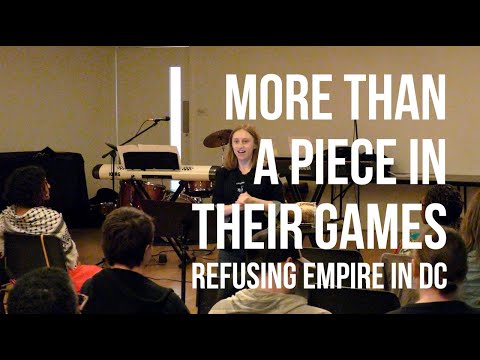
In a city that often feels like the Capitol from The Hunger Games, how do we maintain our humanity and agency? Pastor Heidi Mills explores what Jesus' radical entrance into Jerusalem teaches us about confronting systems of power without becoming what we oppose. Perfect for anyone tired of feeling like a pawn in someone else's game, searching for ways to create meaningful change in a world that prioritizes power over justice. Drawing parallels between ancient Jerusalem and modern DC, this sermon offers four practical strategies for living with purpose in the shadow of empire.
More detail
Chapters8 sections
TranscriptAuto-generated · 3,830 words
Generated automatically from the audio, so names and some words may be wrong. Tap any sentence to hear it.
The Hunger Games and life in DC
A couple of weeks ago, I decided to revisit one of my favorite book series from my childhood, all my teenage years, The Hunger Games by Suzanne Collins. I read the original trilogy for the first time in only a couple of days, and I remember adoring them at the time, but I gained a newfound appreciation for everything that Suzanne Collins is doing in the series now that I'm an adult. So in this In this series, we are introduced to a dystopian version of the United States called Panem, which is divided up into 12 districts and governed by a fascist Capitol.
Every year, every district must send two of its children, one boy and one girl, to fight to the death as tributes in the competition known as the Hunger Games, where only one can survive. Competition is meant to remind the districts of the cost of war and prevent future uprisings like the one that occurred 74 years previously. And this trilogy hits way too close to home
with the Capitol's hyper focus on entertainment and instant gratification. The Capitol controls the districts through propaganda, surveillance, and highly sophisticated forms of manipulation and control, and thrives on an us versus them mentality that regularly spills over into highly public forms of violence. The people in the district only seem like pieces in the Capitol's game of domination and oppression. And in the first book, one of the tributes from District 12, Peeta Mellark, comments on this to his fellow tribute, Katniss Everdeen, right before they enter the arena to fight for their lives. He tells her, I keep wishing that I could think of a way to show
the Capitol that they don't own me, that I'm more than just a piece in their games. This idea of being more than a piece in their games recurs throughout the series as Katniss and Peeta try to maintain their agency in a world that seeks to destroy it. These days, being a resident of Washington DC can often make me feel that I am living in my own version of the Capitol. I have been struggling with the idea that I am subject to forces beyond
my control that seek to harm me and my community. So many people have recently lost their jobs because of budget cuts, and countless others, myself included, feel like their job is constantly on the chopping block. Our ability to govern ourselves is facing new peril as home rule becomes increasingly under attack. The fight to exert our own agency in a world that prioritizes power of prestige and profit over justice can seem like playing a game that we can't win.
As Peeta and Katniss discover through the Hunger Games, it can be difficult to fight oppression without adopting the tactics of the oppressor. How do we remain ourselves in the fight for
Reading Luke 19:28–40
justice? What kind of future are we fighting for anyway? How do we become more than a piece in the empire's games? These are some of the questions that ground the story of Palm Sunday. as Jesus enters Jerusalem on the way to the cross. Jerusalem was not technically a capital of the Roman Empire, but for Jesus and his disciples, it was the epicenter of religious and imperial authority. Jesus lived his entire life under Roman occupation, resubjected his people to to its authority, through any means necessary, including violence.
Our text for today comes from Luke 19, verses 28–40. And I did want to briefly mention that Palm Sunday is included in each of the Gospels and an interesting devotional for Holy Week. Might be to read through each version and note the similarities and the differences.
fun fact is that the only gospel where palm branches are mentioned is John. So here I was reading Luke for the first time, preaching for Palm Sunday, and I was like, where are the palm branches? Turns out they're in John. So the words for the passage will not be on the screen. So I invite you to follow along. If you have a device, pull it up on your phone. And if some of you bought a physical Bible, I don't know if that's the thing that this will do.
But if you do, that's wonderful. Pull it up. Yeah.
After he, meaning Jesus, had said this. He went on ahead, going up to Jerusalem. When he had come near Bethphage and Bethany, at a place called the Mount of Olives, he sent two of the disciples, saying, Go into the village ahead of you.
And as you enter it, you will find tied there a colt that has never been ridden. Untie it and bring it here. If anyone asks you, why are you untying it?
Just say this, the Lord needs it. So those who were sent departed and found it as he had told them. As they were untying the colt, its owners asked them, why are you untying the colt?
They said, the Lord needs it. Then they brought it to Jesus, and after throwing their cloaks on the colt, they set Jesus on it. And as he rode along, people kept spreading their cloaks on the road. Now, as he was approaching the path down from the Mount of Olives, the whole multitude of the disciples began to praise God joyfully with a loud voice for all the deeds of power they had seen, saying, blessed is the king who comes in the name of the Lord. Peace in heaven and glory in the highest heaven. And some of the Pharisees in the crowd said to him,
19:28 · Remember who we are and our calling
teacher, order your disciples to stop. He answered, I tell you, if these were silent, the stones would shout out. This passage illustrates how Jesus refused to be a piece in the empire's games, and by following Jesus's example, we can learn how to do the same in our own time and place. So how to be more than a piece in their games, according to Jesus? One, remember who we are and what we have been called to do. Luke drops us right in the middle of Jesus' mission in verse 28. After he had said this, he went on ahead going up to Jerusalem. For the author of Luke, we can't talk about Jesus'
arrival to Jerusalem without talking about what came before. Jesus' entire life was part of one continuous journey to Jerusalem where Jesus would be crucified and where Jesus would rise again on the third day. Right before Jesus entered Jerusalem, he healed a blind beggar near Jericho. He met with Zacchaeus, a tax collector. He foretold his death and resurrection for a third time to his disciples. He spoke in many parables, including the parable of the
talents. Everything that Jesus did in the lead up to the cross was to show that he had fulfilled the words in Isaiah 61, verses 1–2. The Spirit of the Lord God is upon me, because the Lord has anointed me. He has sent me to bring good news to the oppressed, to bind up the brokenhearted, to proclaim liberty to the captives and release to the prisoners to proclaim the year of the Lord's favor.
Jesus knew that his journey to Jerusalem was also leading to his death. The author of Luke spent 19 chapters up to this point explicitly proving that Jesus knew exactly what was at stake for him. But no one forced Jesus to enter Jerusalem. He deliberately went on ahead. He set himself up for his confrontation with the imperial and religious powers, even though he was entering a game that he knew he would not survive. But he chose to go anyway. What can we learn from Jesus' example as we too live in a capital city which is the center of power and control in this country.
I don't think that we need to run headlong into danger for no reason. That's not what Jesus advocated for. Instead, Jesus knew who he was, what God had called him to do, and he was willing to go where he needed to go and pursue the cause of justice and liberation. By choosing the time and the mode of his entry, he refused to play by the empire's rules. And like Jesus, we could choose how we enter the city. We can refuse to give the city over to those who pursue power and oppression. We can remember that we are called to be peacemakers, even though we live within broken systems.
Will we walk through the city seeking its healing and its liberation, or will we seek to align ourselves with the powerful? Will we act intentionally to disrupt the systems of
19:30–35 · A colt, not a war horse
power and oppression around us? What does that even look like? Once again you can go back to Palm Sunday. 2. Embrace humility and service above power and dominance. Before Jesus entered Jerusalem, he instructed his disciples to go into the village and retrieve a colt that had never been ridden. At first it seems like an odd choice. Why can't Jesus just walk? He's been walking this whole time.
Sorry, Ace the noise makes you laugh in the face. I wasn't expecting that. And why a colt and not a horse? Surely a horse would be more dignified. But the choice of a colt is deliberate. A colt was a humble, unassuming animal. By choosing a colt, Jesus was indicating that he was choosing the way of humility
and service over power and dominance. Jesus talked about this just a few chapters earlier in chapter 19, verse 10. For the Son of Man came to seek out and save the lost. Jesus didn't enter Jerusalem because he wanted to cozy up with those who were in power, but to challenge them through his example of humility and service. As Jesus entered Jerusalem, so did Pontius Pilate. Pilate ruled Judea from a coastal city called Caesarea and he would travel to Jerusalem occasionally, especially during important events like Passover. And Pilate attended these religious festivals to remind the Jewish people
that they were still under Roman control. He'd ride into the city on a war horse, accompanied by his own procession. Think of a presidential motorcade, or better yet, a military parade. But I want to take this a step further. Yes, a colt was a symbol of humility, but for the Jewish people, Jesus' entry had an additional degree of meaning. It fulfilled another ancient prophecy in Zechariah chapter 9, verses 9 through 10. Rejoice greatly, O daughter Zion! Shout aloud, O daughter Jerusalem! Lo, your king comes to you.
Triumphant and victorious is he, humble and riding on a donkey, on a colt, the foal of a donkey. With Jesus at the Jerusalem, he also declares identity as a different kind of king. He joined a line of Jewish kings, who also notably rode into the city on a donkey, like King Solomon in 1 Kings 1, verse 33.
The Jewish people would have understood that Jesus was declaring his own power, but this was a power from service and humility, not might. As Mark chapter 10 verse 45 tells us, The Son of Man came not to be served, but to serve, and to give his life as a ransom for many. I want to first affirm today that so many of us are already following Jesus' example.
So many of us came to D.C. because we wanted to make some kind of positive impact. There are so many ways that we do address systemic injustices like homelessness, racism, homophobia, and poverty, both domestically and abroad, in our work and in our volunteer lives. We thoughtfully consider our impact on the world including our habits of consumption.
We recently finished our sermon series on sacred self-care where we discussed the importance of taking care of ourselves and not working ourselves to the bone to climb some arbitrary ladder. In so many ways, we already refuse to play by the Empire's games through choosing everyday acts of humility, service, and love. But I want us to consider how we might grow in our
ability to do so together as a church. Especially as we are facing this time of chronic uncertainty, what might it look like for us to join together as one community to get brought the injustices within us at each. What does radical service mean in our context? Sometimes for me, I could get into a very individualist mindset where I compare myself to others, trying to meet some arbitrary standards of success, wondering, am I doing enough in my work? Am I doing enough in my volunteer life? Like, what about what other people are doing? And I get to a spiral
about it. But I forget the importance of joining my skills with the skills of other people and coming together to make a difference that wouldn't be possible just on our own. So how can we grow in
Jesus is Lord, so Caesar is not
our ability to together practice revolutionary justice in our time in this? There is no shortage of opportunities. And this leads me to the third way that Jesus shows us how to be more than a piece in the empire's games. Three, proclaim and embody an alternative vision of justice and compassion. When Jesus instructed the disciples to retrieve the colt, he gave one reason: the Lord needs it. This one phrase begins to topple the entire edifice of the Roman Empire's game because that game is built on this idea that Rome had all the power and the authority,
that the emperor was the only one who could be praised, the only one who could subject people to his unique authority. When Jesus declared himself Lord, he also declared that Caesar is not, denying his ultimate authority. And he chose a path that would set him on a course to challenge that authority, that there is a demand that goes beyond the demands of the empire, though the empire sought to demand and destroy through power and exploitation. Jesus unmasked that game by announcing the coming kingdom where everything will be reversed, and the last shall be first, and the first shall be last. A different reign is here, humble,
riding on a donkey. And this reign is not based on power and domination, but on what Jesus had been proclaiming and embodying all along. He healed the sick. He fed the hungry. He restored sight to the blind. He stretched out the boundaries of grace to include everyone within its circle. Jesus chose alternative moves that establish an authority far beyond the power of Rome. And the crowd recognized that. They laid down their cloaks, and that they'll typically precede a Roman official's entry into the city. They boldly declared that Jesus was king and showered him in blessings that would usually only be given to the
the Roman Emperor. And this proclamation drew the attention of those in power. The Pharisees was actually told the crowd to shut up and fall in line. When we proclaim an alternative way of
When we’re told to be silent
life, and we begin to embody that, the risk is great, but the alternative is too painful to comprehend. As Martin Luther King Jr. insightfully said, our lives begin to end the day we become silent about the things that matter. In our time, there are so many people who tell us to be quiet. Authority does not like to be questioned, and shutting down dissent is one of their favorite moves. I remember when Elkechi asked all of us, have we ever felt like we've been needed?
And this is an experience that we frequently have. It's an experience that I have. I remember when I first began to question my conservative religious beliefs after college, and voicing my doubts about things like complementarianism or homophobia or phoationism made multiple people tell me to fall in line, because that's just what the Bible says. And there are other ways we are are told to be silent. I think about the recent erasure of the Black Lives mural in DC, the Black Lives Matter mural in DC. If we cannot affirm the simple fact that Black Lives do matter, then what
can we affirm? This is a very tangible and visible form of silencing that has occurred within our own city. But there are other more subtle and perhaps more insidious ways that silencing dissent could even show up in our own community. As a church, we proclaim that we seek collective liberation and a renewal of all things, but what happens when we fight disagree on the tactics pursuing justice? Whose voices are privileged and whose voices are sidelined or silenced even within our own community? I think about how we may try to skirt around differences and dissent by agreeing
to disagree rather than coming up with a solution that addresses uncomfortable truths or nuance. Sometimes we do need to agree to disagree but other times we might need to prioritize a true peace over false unity. When we did the learning cohort a few years back, I remember discussing that even multiracial churches still default to whiteness. What do we do when those issues arise within our community, with things like worship or preaching or highly
practiced justice in our cities? Do we silence those voices, or do we embody the way of justice and compassion? Like Jesus, we are called to embody and proclaim a different way. And the simplest and
Telling the truth to power
probably most effective way for us to combat the games of empire, which thrive on misinformation and propaganda, is to speak truth to power. One of my favorite Christian thinkers, Rachel Held Evans, once wrote that she kept a sign above her desk that read, tell the truth. Telling the truth in a world that prioritizes and pillages lies is one of the most radical things that we can do to ensure that we don't play the Empire's games. When our faith is used to marginalize and oppress, we can boldly proclaim faith rooted in justice and liberation.
One of the most powerful examples of truth-telling came shortly after the inauguration, when Reverend Mariann Budde from the National Cathedral boldly asked the government to have mercy on the people of the United States who were scared, including immigrants and LGBTQ plus individuals. She refused to back down. She spoke the truth of God's gospel of grace and compassion, even when people tried to shut her down. And I know for me, as someone who is only just beginning on my pastoral journey, that I hope to one day be able to boldly proclaim the truth like she did to power. And I want to encourage us as a congregation to get a little bit more comfortable
with discomfort, especially when it comes to telling the truth. And I think this happens in small ways, like if we witness or someone say a harmful comment about someone else, like, are we willing to go to that person and provide feedback, calling them in, not accusatory, but just saying this is how it felt for me. And are we open to receiving that feedback? Are we open to receiving the truth? I think these are very practical, very small ways that we can begin this practice of truth telling and that will expand into my joys. And this leads me to the fourth and final way
19:40 · The stones would shout out
that we can refuse to be a pawn in the empire's games. Live with the rock solid assurance that resurrection is on the other side of the cross. Jesus had the perfect response to the Pharisees' demand for silence. He answered, I tell you, if these were silent, the stones would shout out. I kind of think, uh, even if the AV system fails us, the stones will shout out. Yes, um, very good sermon illustration there. Um, yeah. Um, and so the stones shouting out means that Jesus' move to Jerusalem cannot be stopped. Jesus would not be turned around and forced to go back to Nazareth.
Instead, Jesus took a journey that led him straight to the cross. Jewish scholar Amy-Jill Levine talks about how risk is an inescapable part of this journey. She says, The triumphal entry cannot be separated from the cross.
And the cross cannot be separated from the call of justice. And that call cannot be separated from risk. Personal, professional, and permanent.
We live in a time of great risk, when we know that standing up against empire and refusing to play their own games has already forced us to take up our own crosses. Many of us have lost our jobs. Many of us also fear that our rights and the rights of our loved ones will be taken away.
All of us are living with the chronic uncertainty of this moment. And Jesus knew the same risk when he went to the cross. In fact, he also knew that human voices would be silent.
That the same crowd that declared Jesus king on Sunday would cry over him to be crucified on Friday. Jesus knew that he was marching to his death. But with his dying breath, he declares, Forgive them, Father, for they know not what they do.
And then Jesus' voice is silenced. But just as the triumphal entry cannot be separated from the cross, the stones still speak. Perhaps we can endure death only because we know that resurrection lies on the other side.
On Sunday, the stone covering the tomb will be rolled away. The stones declare that Jesus is not here, that he is alive. But right now, when we are on the other side of Palm Sunday, before the resurrection, we are faced with a question.
Are we going to be with the rocks crying for Jesus' resurrection, or are we with the crowd yelling crucify him? Every day, our answer could show the Capitol that they don't own us, that we are more than a piece in their games. When we declare that the cross is not the end of the game, Jesus's kingdom has already come, and we see the light of it through everyday acts of justice and compassion. Resurrection is on its way, and there are so many moves that we can make as we face those games of
power and exploitation. So this week, consider one way that you might be able to defy the games of empire. And the options are limitless. We can combat misinformation, we can advocate, we can donate, volunteer, protest, join a mutual aid network. I invite you to make those moves to speak. And as you do, I hope that you remember that the stones do speak. And tell us a simple truth. Fire is catching. Resurrection is coming.